The Center's work on 'Poverty and Income' Issues

The Center analyzes major economic developments affecting low- and moderate-income Americans, including trends in poverty, income inequality, and the working poor. In addition, we analyze the asset rules in various public benefit programs that can discourage low-income people from building modest savings and highlight potential reforms.


North Carolina Should Reinstate Its EITC

May 13, 2013 at 4:04 pm

The Tax Foundation’s Elizabeth Malm recently expressed concern on an issue about which we have already weighed in — North Carolina’s decision in March to eliminate its Earned Income Tax Credit (EITC), which provides important support for low-wage working families.  Before we get to Malm, here’s what you need to know:

North Carolina ended the credit as of next year, which will mean a tax hike for 900,000 working households, most of them with children to support.  Adding insult to injury, policymakers also cut the credit for this, its last year on the books, from 5 percent of the federal credit to 4.5 percent, shrinking an already modest benefit.

I wrote in February about the harm that this action would cause to North Carolina’s struggling working families — at a time when the state had just slashed its unemployment benefits and while lawmakers were considering eliminating the estate tax that’s levied on just 23 of North Carolina’s wealthiest estates.

At a recent debate, Malm described regressivity as “a very important concern” and cited the EITC as “one way that we can mitigate the regressivity concerns that do come up when we think about reducing the income tax.”  Malm and CBPP Senior Fellow Jared Bernstein agreed that North Carolina should revisit its decision to eliminate the EITC.

Meanwhile, the state will likely eliminate its estate tax, and lawmakers are considering major tax plans that would force low-income families to pay a greater share of their income in taxes while reducing the taxes of the wealthiest North Carolinians.  They should rethink tax cuts for the wealthy, especially when they come at the expense of tax credits like the EITC that help working families support themselves.

Working-Family Tax Credits Lift Millions of Mothers — and Children — Out of Poverty

May 10, 2013 at 2:10 pm

With Mother’s Day approaching and policymakers considering overhauling the tax code this year, it’s worth noting that two key tax credits for low-income workers lifted 2.3 million mothers out of poverty in 2011 (the most recent year available), using a Census Bureau poverty measure that counts tax credits and government benefits.

Our new fact sheet gives state-by-state figures on how many mothers in working families benefit from those credits — the Earned Income Tax Credit (EITC) and the Child Tax Credit (CTC).

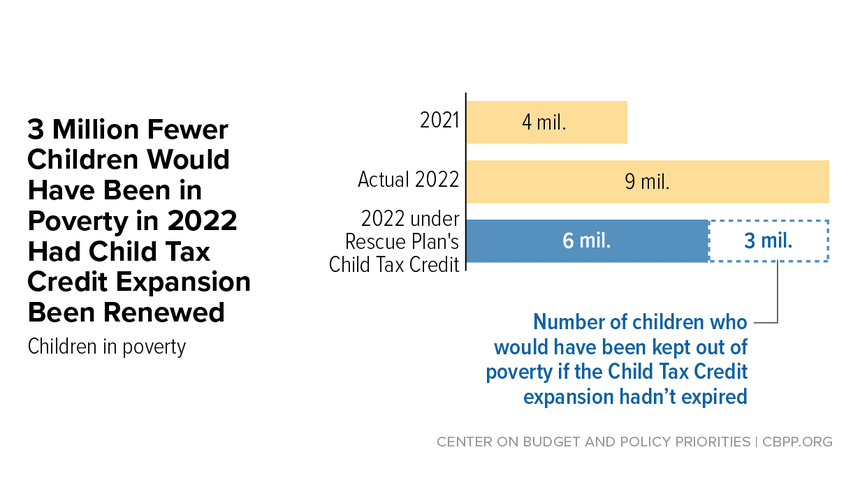
The EITC and CTC not only help working parents make ends meet but are proven, powerful tools for reducing child poverty — lifting 4.9 million children out of poverty in 2011 — and advancing children’s long-term well-being.  Children of EITC recipients, for example, tend to do better in school, are likelier to attend college, and earn more as adults, research shows.

For more, see our backgrounders on the EITC and CTC.

Benefits of the Earned Income Tax Credit Extend to the Next Generation

April 17, 2013 at 3:33 pm

Roughly 27 million working families with low or moderate incomes received the Earned Income Tax Credit (EITC) this tax season to help offset their federal income and payroll taxes.  The EITC encourages work, research has long shown; the EITC expansions of the 1990s did as much to expand work among single mothers as did welfare reform of 1996.  And, exciting new research shows that the EITC’s benefits extend beyond working parents to their children — both when they are young and as adults, as our revised paper explains.

  • Healthier infants. Researchers compared changes in birth outcomes for mothers who likely received the largest increases in their EITCs under the 1990s expansions and mothers who likely received the smallest increases.  They found that infants born to mothers who likely received the largest increases had the greatest improvements in a number of areas, such as low-weight births and premature births.
  • Better school performance. Researchers who studied nearly two decades of data on mothers and their children concluded that additional income from the EITC leads to significant increases in students’ test scores. Similarly, a credit that’s worth about $3,000 a year during a child’s early years may boost his or her achievement by the equivalent of about two extra months of schooling.
  • Higher earnings as adults. Children whose families receive income from refundable tax credits (such as the EITC) are likelier to attend college; they also likely work more and earn more as adults (see graphic). Those same children are also likelier to avoid the early onset of disabilities and other illnesses associated with child poverty, which further enhances their ability to earn more as adults.

SSI: Helping the Poorest Elderly and Disabled Americans

April 16, 2013 at 3:07 pm

The National Senior Citizens Law Center and Latinos for a Secure Retirement will host an event tomorrow to spotlight Supplemental Security Income (SSI) — an important but oft-ignored program that provides cash income to people who are disabled, blind, or elderly and have little income and few assets — and discuss ways to improve it.

President Nixon and Congress created SSI in 1972 to replace the matching grants to states that had created what the Social Security Administration (SSA) called a “crazy quilt” of aid to the aged, blind, and disabled.  SSI is distinct from the Old-Age, Survivors, and Disability Insurance (OASDI) programs commonly known as Social Security, though many SSI recipients have worked enough that they also collect Social Security and SSA runs both programs.

In December 2012, 8.3 million people collected SSI:  2.1 million people aged 65 or older, 4.9 million disabled adults aged 18-64, and 1.3 million severely disabled children under age 18.  Until the deep economic downturn generated a modest uptick, SSI participation had generally been flat or falling as a share of the population since at least the mid-1990s (see graph).

SSI benefits alone don’t lift recipients out of poverty; the maximum benefits for individuals and couples (when both spouses qualify) are about 74 percent and 83 percent of the poverty level, respectively.  But SSI is instrumental in reducing extreme poverty (incomes below half the poverty line).  SSI benefits are lower when recipients have other income (or live in a Medicaid facility or with relatives who provide support), so the average federal payment is $500 a month.

Improvements in SSI should aim to boost participation among eligible people and make benefit levels more adequate.  Possible reforms include raising the basic benefit, raising and indexing the badly outdated asset and income limits (the asset limits have been frozen since 1989), changing rules that discourage saving for retirement, and extending SSI eligibility for elderly or disabled refugees, a uniquely vulnerable group.

Bernstein on the Minimum Wage

April 16, 2013 at 2:00 pm


In a live, Oxford-style debate by Intelligence Squared, CBPP Senior Fellow Jared Bernstein argued against a motion to abolish the minimum wage.  Along with his teammate Karen Kornbluh, former U.S. Ambassador to the Organization for Economic Cooperation and Development, Bernstein made the case that abolishing “a simple policy that, for 75 years, has been doing what it’s designed to do with little fanfare and minimal, if any, negative side effects… makes absolutely no sense at all.”

During the debate earlier this month, Bernstein presented a common sense thought experiment:

The American minimum wage, as you’ve heard, has been in place since 1938, 75 years ago. It has been raised 22 times. Nineteen states now have their own minimum wages above the federal level. If this policy was so damaging, as damaging as [the opposing team] claims, that it needs to be abolished, how could it be that citizens and legislatures in 19 states decided not to abolish it, but to raise it above the federal level? If it was anywhere near as damaging as our opponents claim, how could the minimum wage not only have survived this long, but have flourished and expanded? The answer, once again, is because it’s widely understood and accepted by mainstream economics, policymakers, and perhaps most importantly, low-wage workers themselves, who overwhelmingly support the policy … as doing what it’s supposed to do, steering a bit more of the economic growth their way.

And he explained some of the harmful unintended consequences of abolishing the minimum wage:

If you abolish the minimum wage, and it falls a lot, you will collect fewer payroll taxes. You will have to pay more in food stamps…. You have to pay more in welfare benefits. And it is very much a transfer of the burden of poverty to the taxpayer in ways that minimum wages and living wages help to mitigate.

By the end of the debate, more of the live audience agreed with Bernstein and Kornbluh, with 67 percent voting against the motion to abolish the minimum wage (see chart).

See the full transcript here and listen to the podcast here.