The State and Local Drag on the Recovery

June 8, 2012 at 2:30 pm

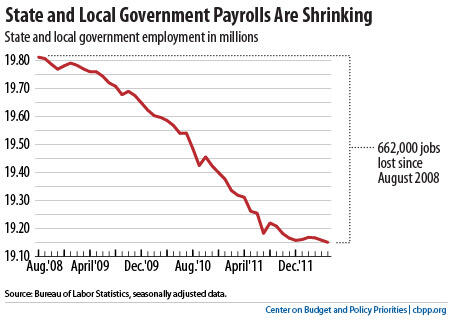
President Obama pointed out this morning that job losses among state and local governments are slowing the recovery.  The graph shows what he’s talking about:  states and localities have shed 662,000 jobs since employment in this area peaked in August 2008.

A couple of other points are worth noting:

  • When measured as a share of the population, the number of state and local government jobs has fallen in 37 of the last 40 months.
  • The number of state and local jobs outside of education (in other words, law enforcement, parks, transportation, and so on) is the lowest it’s been since June 1985, as a share of the population.

The large-scale job losses we’ve experienced slow the economy by weakening consumer demand, since people who lose their jobs must scale back their spending dramatically.

And, due to the services that states and localities provide — education, public safety, health care, and the like — these job losses also can have a real impact on residents’ quality of life.

More About Nicholas Johnson

Nicholas Johnson

Johnson serves as Vice President for State Fiscal Policy.

Full bio | Blog Archive | Research archive at CBPP.org

1 Comments Add Yours ↓

Comments are listed in reverse chronological order.

  1. Zlati Petrov #
    1

    I think we ought to consider the mobility of the people losing their jobs. Do teachers, firefighters, etc. have the sorts of skillsets that allow them to migrate quickly into jobs in the private sector?

    If not, then they flow out of the stock of employed workers and into that of unemployed workers. If they do, then they might flow out of the stock of government workers and into the stock of private sector workers, in which case it does not follow that lay-offs weaken demand just by virtue of the pink slip (though they may in other ways).

    What studies exist which track these laid off workers to trace their flows across various labor stocks?

    Also, I suppose the most obvious (and trite?) retort to the post would argue that declining government payrolls imply lower taxes to support government spending in the future. If we hypothesize, through a whole web of additional arguments, that lower expected taxes somehow increase private sector hiring, we would need to see whether this latter effect outweighs the effect of public sector lay-offs over various time horizons.

    Of course, we also need to consider the possibility that public sector workers actually have a higher marginal product at their government jobs (i.e. as teachers) than they would in the private sector (i.e. as secretaries). A free market economist might find this repugnant, but I don’t think it’s inconceivable.

    So this all seems terribly complex. Too many variables to analyze. Where do you even begin?


Your Comment

Comment Policy:

Thank you for joining the conversation about important policy issues. Comments are limited to 1,500 characters and are subject to approval and moderation. We reserve the right to remove comments that:

  • are injurious, defamatory, profane, off-topic or inappropriate;
  • contain personal attacks or racist, sexist, homophobic, or other slurs;
  • solicit and/or advertise for personal blogs and websites or to sell products or services;
  • may infringe the copyright or intellectual property rights of others or other applicable laws or regulations; or
  • are otherwise inconsistent with the goals of this blog.

Posted comments do not necessarily represent the views of the CBPP and do not constitute official endorsement by CBPP. Please note that comments will be approved during the Center's business hours. If you have questions, please contact communications@cbpp.org.


 characters available