
Poverty Rate Would Nearly Double Without the Safety Net
http://www.offthechartsblog.org/poverty-rate-would-nearly-double-without-the-safety-net/
Posted by: Arloc Sherman
Posted in: Earned Income Tax Credit, Federal Tax, Food Assistance, Food Stamps, Individuals and Families, Poverty and Income, Recession and Recovery, Trends, Unemployment
As Georgetown University’s Peter Edelman explained in yesterday’s New York Times, the serious hurdles that this nation faces in ending poverty shouldn’t obscure our real achievements in this area over recent decades. He cites a CBPP estimate that poverty would be nearly double what it is now if not for programs like the Earned Income Tax Credit and SNAP (formerly food stamps).
Here are the specifics, as we outlined them last fall:
[S]ix recession-fighting initiatives enacted in 2009 and 2010 kept nearly 7 million people out of poverty in 2010 — under an alternative measure of poverty that takes into account the impact of government benefit programs and taxes. . . .
[I]f the government safety net as a whole — these temporary initiatives (all were featured in the 2009 Recovery Act) plus safety-net policies already in place when the recession hit — hadn’t existed in 2010, the poverty rate would have been 28.6 percent, nearly twice the actual 15.5 percent (see graph).
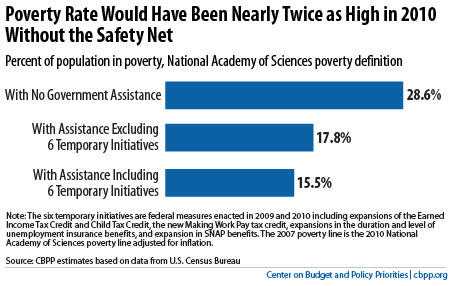
This shows the powerful anti-poverty impact of policies ranging from tax credits like the Earned Income Tax Credit and Child Tax Credit to unemployment insurance, SNAP (food stamps), Social Security, Supplemental Security Income, veterans’ benefits, housing assistance, and others.


This is complete nonsense.
You’re comparing two entirely different things.
The US poverty rate does not include the effects of SNAP, EITC, Medicaid, Section 8 and so on.
So, you must either compare the poverty rate under the classical measure (not including them) or under the new measure (including them). And without moving off into relative poverty measures (40% of median, whatever).
I’ll agree that if you abolished those programs then many more people would be much poorer. I think the programs are a good idea too. But that doesn’t stop your comparison from being nonsense.
The problem this this:
“hadn’t existed in 2010, the poverty rate would have been 28.6 percent, nearly twice the actual 15.5 percent (see graph).”
You are counting those lifted out of poverty under the laternative measure. But not those lifted out under the classical measure under the same policies.
What is the poverty rate using the classical measure if we then add in the incme from the EITC, Section 8, SNAP and so on. It’s a lot, lot lower than that 15% which is why your comparison is absurd.
Tim, you correctly describe the right way to estimate how many people the safety net lifts out of poverty: compare apples to apples. This is exactly what we did, though our description should be clearer than it evidently is.
Our analysis used a single definition of poverty — a National Academy of Sciences-style definition that the Census Bureau has developed. We measured the poverty rate under that NAS-style definition both with and without certain government benefits.
Under the NAS-style definition, a person’s income includes:
•wages, salaries, and other cash income other than government assistance (like interest, dividends, and alimony);
•government cash benefits (like Social Security and unemployment insurance);
•government non-cash benefits (like food stamps and rental assistance); and
•the net effect of taxes (in other words, the difference between federal and state income and payroll taxes owed and tax credits received, such as the Earned Income Tax Credit).
The NAS-style definition then subtracts certain expenses that reduce a person’s disposable income, including necessary medical and work-related expenses. And it uses a poverty line that is modestly different than the official poverty line.
We found that the poverty rate in 2010 under this NAS-style definition was 15.5 percent. Then we estimated the poverty rate under this same NAS-style definition but without counting benefits and taxes (in other words, the second, third, and fourth bullets above); we found that the poverty rate for 2010 was 28.6 percent. In other words, the poverty rate would have been nearly twice as high without the government policies.
I hope this is reassuring.