
Five Things You Might Not Know About Public Employees
http://www.offthechartsblog.org/five-things-you-might-not-know-about-public-employees/
Posted by: Elizabeth McNichol
Posted in: Budgets, State Budget and Tax
Our brief new report on state and local workers includes some basic facts worth keeping in mind in the heated current debate over public employees.
1. Education is by far the largest category of state and local government employment. Nearly 7 million teachers, aides, and support staff work in the nation’s public elementary and secondary schools, more than twice as many as in the next largest job category (protective services, which includes police officers, fire fighters, and correctional officers).
2. Outside of education, the public workforce has shrunk as a share of the population over the last three decades. Counting education, the number of state and local workers has grown modestly relative to the overall population, from about 59 per 1,000 in 1980 to 62 per 1,000 in 2010.
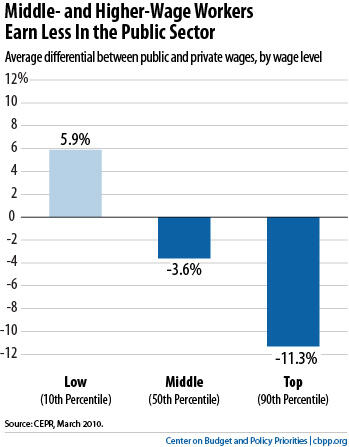
3. Public-sector workers earn less than their private-sector counterparts. The typical middle-wage worker earns about 4 percent less in the public sector than the private sector. Low-wage state and local workers, by contrast, receive a small wage premium (see graph).
4. Public-sector workers also earn less than their private-sector counterparts when one counts both wages and benefits. Benefits like pensions and health insurance are more generous and secure for public employees than for most private-sector workers, but factoring in the value of these benefits does not eliminate the gap between state and local employees and their counterparts in comparable private-sector jobs.
5. Labor costs make up a significant share of state and local spending. This reflects the fact that providing services is the primary business of states as well as school districts, cities, counties, and other local governments. Total compensation for state and local workers (including wages and benefits) makes up about 44 percent of state and local spending.



The job positions you described are not middle-wage jobs. Critique is invalid. Also note that these are average values. Individual local or state governments may vary drastically compared to the average. Anecdotal assertions do not threaten the validity of the study, which has a much larger scope.
The minimum wage in Illinois is $8.25 per hour.
I work in the private sector as a security officer at a hospital for $8.25 per hour.
I also know hospital housekeeping staff that works for minimum wage at the hospital.
I also know for a fact, that the starting salary for a janitor working for the state of Illinois is over $22 per hour.
Point 3 on your fact sheet is false.
Elizabeth,
Thank you so much for writing this: “Public-sector workers also earn less than their private-sector counterparts when one counts both wages and benefits.”
Is this true for federal employees as well?
Thanks,
Tyler
Just as with state and local employees, it is important to take into account the different types of jobs and different education requirements and other features of those jobs to accurately compare federal employee compensation to private sector compensation.
There is no easy answer to your question but here are two recent articles that address these issues. A piece by the Annenberg Public Policy Center: http://factcheck.org/2010/12/are-federal-workers-overpaid/ and a report by the Center for American Progress http://www.americanprogress.org/issues/2010/10/federal_pay_myths.html