Different Charts, Same Picture
http://www.offthechartsblog.org/different-charts-same-picture/
Posted by: Nicholas Johnson
Posted in: Economic Recovery Watch, Federal-State Issues, Recession and Recovery, State Budget and Tax, States in the Recession, Unemployment
Congress is back in session and will consider extending the parts of last year’s Recovery Act that have provided extra weeks of jobless benefits and aid to cash-strapped states. The graphs below show why it needs to do both.
While recent data suggest that job losses and state revenues may have bottomed out, both are in deep holes and will continue to cause serious problems for the economy unless Congress acts to cushion the blows.
Let’s take these problems one at a time.
First, states are facing a historic drop in revenues, as the graph shows. To keep their budgets in balance, states and localities are cutting deeply — with disastrous results for services and jobs. Some 900,000 public- and private-sector jobs could be lost in the coming year if states have to close their entire shortfalls without additional federal help.
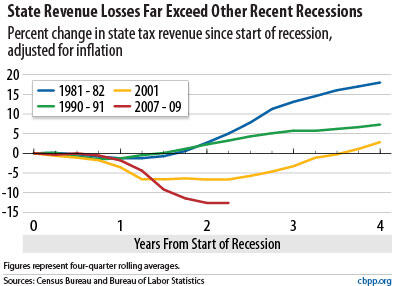
A new Rockefeller Institute of Government report noted a slight uptick in revenues for the January-March period but explained that it was only because California and New York raised tax rates and “does not indicate broad fiscal recovery.” States’ underlying tax base remains far below pre-recession levels. So there’s still not enough revenue to meet states’ responsibilities in areas like health care and education.
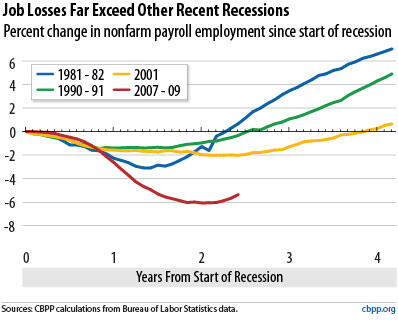
Second, it’s the same story on unemployment. The economy is starting to add jobs, but as the graph below shows, we’ve got a long, long way to go to close the huge jobs deficit that the recession has created.



One of my daughters lives in LA. CA has been going through massive budget contraction, as you know, and yet there is no support for changing course. Why? Lots of reasons, none of them addressed by reciting projections about job losses.
For example:
1. Lots of people believe state and even local employees are overpaid. The actual focus of anger is usually on benefits, much of which are due in the future but which obviously have a current cost. This means lots of people are in favor of forcing state and local government to confront benefit costs and they believe that will only be done if the thumbscrews are tightened. This is a tough argument to defeat because government benefit costs are high.
2. Lots of people believe state spending is wasteful. They point to your basic laundry list of failures – this or that project failure, some theft loss here. In CA, for example, much is being made of welfare money being withdrawn at casino ATM’s (because the software on the ATM’s wasn’t robust enough to stop that). That most state money is not wasted isn’t the point. Let me explain. In law school, you’re taught that punishment has 3 purposes, deterrence to person, deterrence to others and revenge (as an expression of social and moral outrage). Much public reaction is revenge, meaning it expresses social outrage, justified or not, so the theft of benefits by some means all should be cut off (at least in the abstract). There is also an ill-founded belief that being tough will deter others, a belief that people often hold – as with capital punishment or prison sentences generally – without much evidence, just because they want to believe their actions work. That is, to be clear, people want to feel, need to feel their actions aren’t just vengeful but have a teaching component, even when they’re deluding themselves.
So I find your post extremely unconvincing because it doesn’t even try to grapple with how the issues are perceived.