CBO: Up to 2.9 Million People Owe Their Jobs to the Recovery Act
http://www.offthechartsblog.org/cbo-up-to-2-9-million-people-owe-their-jobs-to-the-recovery-act/
Posted by: Michael Leachman
Posted in: Economic Recovery Watch, Recession and Recovery, State Budget and Tax, States in the Recession, Unemployment
A new Congressional Budget Office analysis finds that the 2009 Recovery Act (ARRA) is continuing to save jobs and protect the economy from what would have been a much deeper recession. As we describe in an updated analysis, in the second quarter of 2011 the Recovery Act:
- increased the number of people employed by between 1.0 million and 2.9 million,
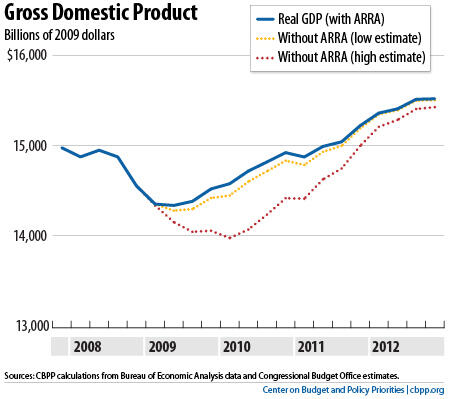
- increased real GDP by between 0.8 percent and 2.5 percent (see chart below),
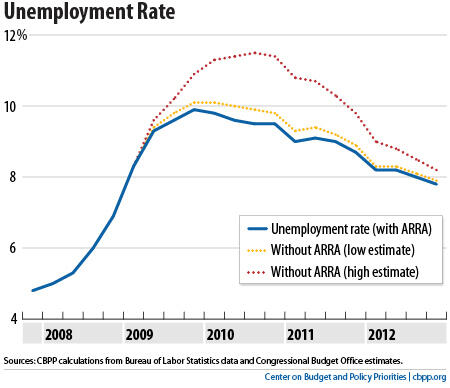
- reduced the unemployment rate by between 0.5 percentage points and 1.6 percentage points (see chart below), and
- boosted the number of “full-time-equivalent” jobs by between 1.4 million and 4.0 million, both by saving jobs and by boosting the number of hours worked. (Without the Recovery Act, many full-time workers would have been reduced to part-time status and fewer would have worked overtime.)


For these and other charts on the economy, see our updated chart book.


Hello;
Thanks for the charts.
Agreed that AARA helped keep jobs , which is good.
But what I don’t understand is why the GDP and its growth rate don’t slip back to the “Without ARRA” levels once the stimulus money is spent. Can you explain that?
Also what is CBO assuming that accounts for the upward slope on GDP, and downward slope on unemployment rate -post 2011?
P.S. it looks like the Without ARRA high/low designations on the GDP chart are transposed
Thanks
Thanks for your comment.
First, ARRA will not be fully spent for some time yet. It included certain longer-term investments (e.g., certain infrastructure projects) that are still rolling out.
Second, CBO believes the economy will gradually recover over the next couple years, with growth picking up after 2013. The modest growth in the next couple years, CBO says, will be driven by “continued strength in business investment, modest increases in consumer spending, and expansions in net exports and residential investment.” (See this for more info.)
Finally, the high and low estimates shown in the graph refer to CBO’s estimates of ARRA’s impact on GDP. So, without ARRA, GDP would have been much lower than it actually was using CBO’s high-end estimate of ARRA’s impact, and somewhat lower than it actually was using CBO’s low-end estimate of ARRA’s impact.