
Inequality and the High-End Bush Tax Cuts
http://www.offthechartsblog.org/inequality-and-the-high-end-bush-tax-cuts/
Posted by: Chuck Marr
Posted in: 2001/2003 Tax Cuts, Deficits and Projections, Federal Budget, Federal Tax, Individuals and Families, Taxes and the Economy
UPDATE, SEPTEMBER 30: We’ve revised some of the figures in this post. Click here for the updated numbers.
As I’ve said before, from the standpoint of economic efficiency there’s a clear-cut case for letting the Bush tax cuts for people over $250,000 expire on schedule in December. Sunsetting the high-income tax cuts makes just as much sense from the standpoint of equity. Recent data from the Congressional Budget Office (CBO) show a stunning shift in income away from the middle class and towards the highest-income people in the country over the last three decades:
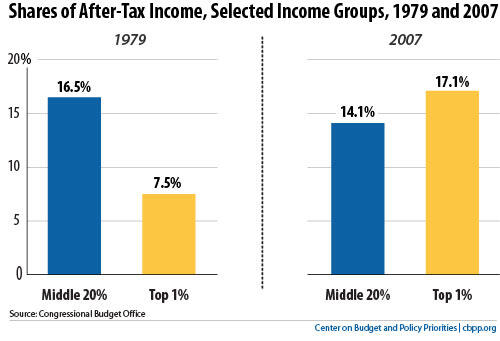
- In 1979, the middle fifth of Americans took home 16.5 percent of the nation’s total after-tax income. By 2007, after several decades of stagnant incomes in the middle and surging incomes at the top, the middle fifth’s share had dropped to 14.1 percent. Over the same period, the top 1 percent’s share more than doubled, from 7.5 percent of total after-tax income to 17.1 percent (see graph below). So by 2007, the top 1 percent had a bigger slice of the national income pie than the middle 20 percent.
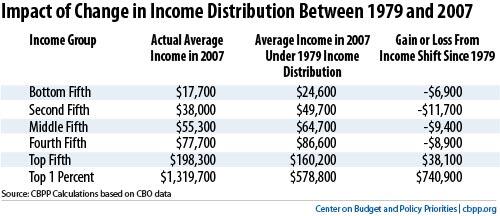
- If the distribution of after-tax incomes had remained unchanged between 1979 and 2007, the after-tax income of the average family in the middle would have been $9,000 (16 percent) higher in 2007 than it actually was. Instead of an income of $55,300, this typical family would have had $64,700 (see table below).
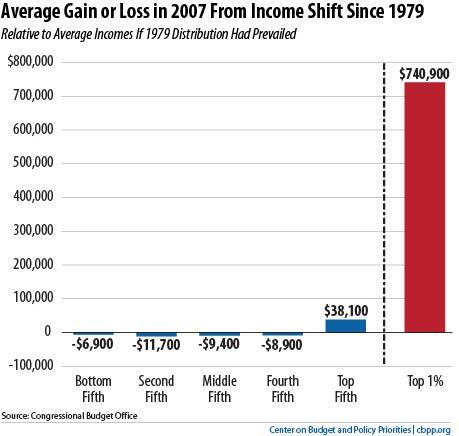
Here’s how that income shift looks in graph form:
Tax policy is one of the best tools we have to help offset the troubling trend of growing inequality. Unfortunately, the Bush tax cuts have had the opposite effect, providing much larger benefits — both in dollar terms and as a percentage of income — to people at the very top than to middle- and lower-income people. People making more than $1 million get an average of about $124,000 each year in tax cuts, according to the Urban-Brookings Tax Policy Center. The main reason, of course, is the large tax cuts targeted specifically at high-income households.
So this fall, when policymakers decide whether to extend the high-end tax cuts, they should keep in mind just how unequal incomes in the United States have become. As former Federal Reserve Vice Chairman Alan Blinder wrote recently in the Washington Post, is the rationale for extending these tax cuts “that America needs more income inequality? Seems to me we have enough.” To me, too.


The thing to recognize is that due to women entering the workplace, technology advances, and losses in worker’s rights caused by keeping the economy depressed (because if you’re broke and your job is in peril you will take less vacation and work harder to keep it), American workers are among the most productive in history in terms of wealth generation. Over the past thirty years our we create more wealth-per-worker-hour than almost anybody ever has.
And as the last table shows, the wealthy have kept ALL of that additional wealth. ALL of it.
That wealth could be fueling the economy (but that would make it more stable, increase worker job confidence, and drive up wages). That wealth could be repairing our infrastructure, improving our schools, helping small businesses innovate, and of course paying down our incredible national debt. But instead it is being gambled on Wall Street as the pathologically wealthy attempt to move themselves another notch higher in the rankings of the world’s wealthiest people.
And of course the other thing they’re doing with the money: expanding their corporate fiefdoms, securing their control over the mainstream media (which they have turned into a propaganda empire), and funding faux populist movements like the Tea Party in order to release pressure which would otherwise turn against them.
what I would like to know is this: are these figures an average of all incomes during these time periods; for instance, are there more people on welfare in 2007 than in 1979? and in deciding whether to let all the tax cuts sundown, what will the overall affect be on small businesses, even ones that show a profit of under $250,000.00? We are small business owners with 12 employees. we are in a very low income county in N Florida. also, part of the tax cuts are on inheritances. taxes are already paid on all that money, why should it be taxed again? i believe this is double taxation and how many of you out there really want to lose 40% of what little bit your parents might leave to you, or your children lose 40% of what little bit you might be able to leave to them? this type of thought causes people to be lazy and not desire to be successful as their rewards for working longer hours and harder than others will be to be penalized financially for it. if the money is taken from those who’ve made many, many sacrifices and given to those who have no ambition, then we are no better than Venezuela.
The 2007 figures are actual and, yes, they are averages for those income groups. The purpose of the analysis was to show just how stunningly income has shifted towards people at the top of the income scale and away from those in the middle and at the bottom. As far as welfare, note that during the 1990s, the Congress enacted a major welfare reform such that the program that existed in 1979 is very different from the program today, which has work requirements, time limits, etc.
The 97 percent of people with business income whose income is below $250,000 would be completely unaffected if the cuts in the top two tax brackets were sunset. If all of the tax cuts were sunset then all taxpayers would be affected, but neither side of the tax debate is proposing this.
Think about both you and your employees. You all pay payroll taxes and income taxes on your wages. This income is taxed twice. Therefore the point that inheritances are taxed twice needs to be kept in perspective. Keep in mind, however, that a large share of inheritances have never been taxed because they come in the form of capital gains (the tax on which is forgiven at death).
Consider the following illustrative example: Assume the estate tax law in 2009 prevailed today (note: right now there is no estate tax) and that each person was provided a $3.5 million tax-free exemption. Further suppose a father invested $1 million in a blue chip stock when he was a young man and that it grew to $3.5 million right before he died. His daughter inherited the stock and sold it for $3.5 million cash. Because of the forgiveness of capital gains at death, the father never paid taxes on the share appreciation and because of the $3.5 million tax-free exemption, the daughter paid no tax either. Now compare her situation to a middle class family who makes a similar amount of money over a lifetime and pays income and payroll taxes out of every paycheck.
Redistribution of income is not the roll [sic] of the Federal Government.
I don’t understand why the Democrats don’t introduce a bill structuring tax cuts for the middle and lower incomes and ignore the Bush tax cuts.
The end result is that the Republicans would have to either vote for or against middle and lower income tax cuts. Meanwhile, any increase in taxes – whether for all taxpayers or just for the highest incomes – would be a direct result of the language in the Republicans’ own tax legislation passed during the Bush administration.
So you are in the top 1% ?
I remember seeing an analysis of how incomes shifted in this century. The point is that hard-heads and others who just want to buy the GOP line on tax cuts despite its lack of rationality point at 1979, point at the tech bubble bursting and say these make all the difference. It would be helpful if you could focus the discussion more.