BEYOND THE NUMBERS
Health Reform’s Medicaid Expansion a Plus for States
In fact, states — and their residents — will benefit in a number of ways from the expansion, and the federal government will pick up almost all of the tab, as our report explains.
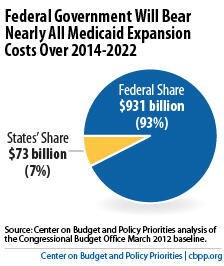
Under health reform, Medicaid and the Children’s Health Insurance Program (CHIP) will cover an estimated 17 million more low-income adults and children by 2022, most of whom are now uninsured. States will bear little of the cost:
- The federal government will pay 93 percent of the cost of the Medicaid expansion from 2014 to 2022, according to the Congressional Budget Office. (By comparison, it covers an average of 57 percent of the costs of covering people in Medicaid today.)
- States will spend just 2.8 percent more than what they would have spent on Medicaid over this period without health reform.
Health reform will also save states money in a number of ways. States and localities pay for many health services for the uninsured: they paid more than $10 billion toward hospital care for the uninsured in 2008, for example, and provided nearly $15 billion in funding for state mental health agencies in 2006.
In 2014, when millions of the uninsured qualify for Medicaid, the federal government will pick up a substantial share of these costs. In fact, Urban Institute researcher John Holahan has observed that states’ savings on care for the uninsured may fully offset their new costs related to the Medicaid expansion.