
Deep Poverty Increases in 28 States, Reaches Record High Nationwide
http://www.offthechartsblog.org/deep-poverty-increases-in-28-states-reaches-record-high-nationwide/
Posted by: Arloc Sherman
Posted in: Economic Recovery Watch, Poverty and Income, Recession and Recovery, Trends
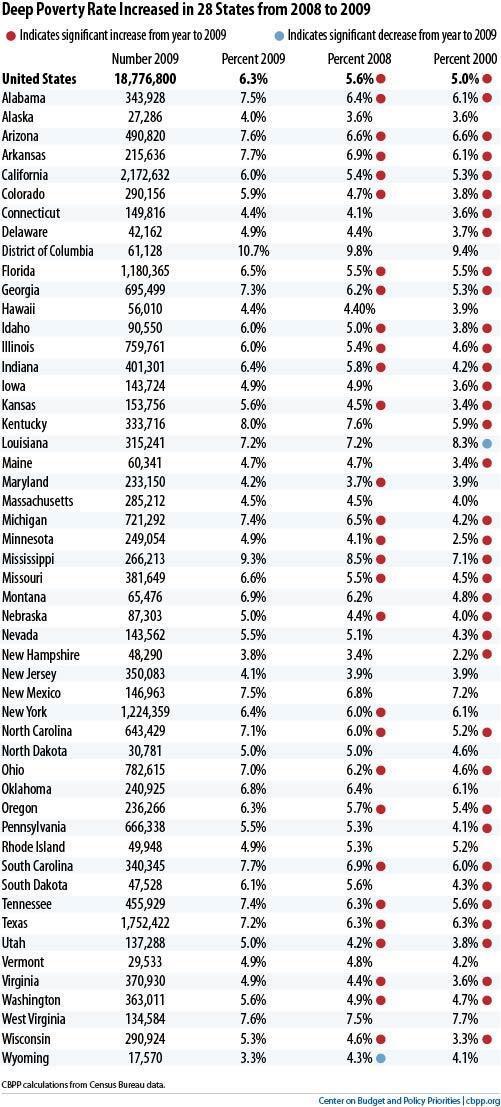
Following up on its September 16 release of national data on poverty in 2009 (which we analyzed here), the Census Bureau today released poverty data for the state and local levels showing that poverty rose in 31 states and fell in none. We analyzed the new data and found that the percentage of people in deep poverty — that is, with incomes below half the poverty line — rose by a statistically significant amount in 28 states in 2009. (See table.) It dipped in one state, Wyoming. Between 2000 and 2009, the share of the population living in deep poverty increased in 36 states.
Half of the poverty line corresponds to an income of $5,478 for an individual and $10,977 for a family of four.
The states with the highest rates of deep poverty in 2009 were Mississippi and Kentucky, where the shares of residents below half the poverty line were 9.3 percent and 8 percent, respectively. The state with the largest increase in deep poverty in 2009 was Colorado, where the deep poverty rate rose from 4.7 percent to 5.9 percent — an increase of more than one-fourth in a single year.
The earlier, nationwide Census figures showed that the number of people in deep poverty hit a record high in 2009, in data going back to 1975. Nineteen million people, or 6.3 percent of the population, were below half the poverty line in 2009, up 2 million from 2008. And 43.7 percent of poor people were below half the poverty line in 2009, also the highest on record.
Since the start of the recession in 2007, the number of people in deep poverty has risen 22 percent, even faster than the increase in regular poverty (17 percent).
Studies have found that deep poverty has a particularly strong effect on the education and development of young children. Even relatively small changes in incomes among low-income young children are associated with significant changes in school achievement.


From my perspective as a businessman, Arloc Sherman’s last paragraph highlighting the alarming impact of increased poverty on school achievement should be the takeaway from these statistics. According to the National Assessment of Educational Progress, whose 2009 results were released in March:
• 90 percent of low-income black students in high-poverty schools were not reading at grade level by fourth grade.
• 82 percent of Hispanic students in schools with low or moderate rates of families living in poverty did not read at grade level.
These are large swaths of the population that we are going to lose to crime, homelessness and an endless cycle of social service support if we do not address this critical issue.
As a result, even in this era of spending cuts, putting human capital first may be a budgetary principle that works to limit unemployment even in tough times. Human capital is the important economic resource of advanced economies. The strength of families and the quality of child care and education directly determine the quality of workforces, global competitiveness, productivity, growth and job creation. As House Budget Committee Chairman John Spratt said a few months ago, “If we don’t get human capital right, little else matters.” This view is borne out in a Bureau of Labor Statistics study. In the U.S. in 2009, the unemployment rate for high school dropouts (30% of the population) was 14.6% versus 5.2% for college graduates.
Unless the U.S begins to seriously rethink its priorities and increase investment in human capital, high unemployment and poverty will be our future, indefinitely. Our top priority should be investing in people, which will keep them employed and begin to minimize the devastating impact of poverty on today’s young learners, and tomorrow’s workforce.
-Robert H. Dugger, Hanover Investment Group, Alexandria, VA