
Another Misguided Charge Against Health Reform

June 29, 2010 at 1:20 pm

Critics claim that the new health reform law’s expansion of Medicaid eligibility will place heavy new financial burdens on states and prompt large numbers of insured people to drop their private coverage for Medicaid.  The first claim is incorrect, as I explained recently, and here’s why the second one is too:

In recent years, a dozen states have expanded Medicaid to cover adults with incomes at or above the poverty line.  If expanding Medicaid really “crowd outs” private insurance to a large degree, these states should have significantly lower rates of private coverage among low-income adults than other states.
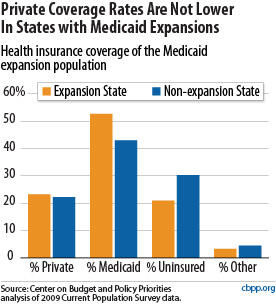
They don’t.  In those dozen expansion states, an average of 23 percent of Medicaid-eligible adults have private coverage; in other states, 22 percent do.

Moreover, the expansion states have a much lower proportion of low-income residents who are uninsured (21 percent compared to 30 percent).

In other words, expanding Medicaid has reduced the ranks of the uninsured without undermining private coverage.

Similarly, several research studies have found little or no crowd-out when states expand public health insurance programs.

One likely reason is that many low- and moderate-income people don’t have access to private health coverage in the first place.  In 2005, just 34 percent of non-elderly workers with incomes below the poverty line were offered coverage through their job.  And many of those offered coverage can’t take it because they can’t afford the premiums.

What all this means is that the vast majority of the 16 million adults and children that the Congressional Budget Office estimates will gain Medicaid coverage by 2019 under the health reform expansion would have otherwise been uninsured.

More About January Angeles

January Angeles

January Angeles is a Policy Analyst at the Center on Budget and Policy Priorities, focusing on Medicaid and state health policy issues.

Full bio | Blog Archive | Research archive at CBPP.org

3 Comments Add Yours ↓

Comments are listed in reverse chronological order.

  1. Brad #
    1

    So the data is limited at this time and a bit hard to draw sweeping conclusions on. Title of this blog piece, IMHO, needs a bit toning down. Incidentally, I have no ideological ax to grind here, I am just looking for truth. Needless to say, thanks so much for responding and posting.
    Brad

  2. Brad #
    2

    What was the private coverage %, on average, in the expansion states BEFORE Medicaid was enlarged? It is unclear in the graph–23 vs 22%–and if is possible that coverage might have been 30% before expansion, and as a result of changes, there might have been a migration. Please clarify.
    Thanks
    Brad

    • 3

      Thank you for your important question, Brad. Due to data limitations, we are only able to conduct historical analysis for two of the twelve expansion states – Arizona and New York, which expanded Medicaid coverage to poor adults in 2000 and 2001, respectively. In these two states, the decline in private coverage since the expansions has been no steeper than in non-expansions states.

      Private insurance has declined by 6% in Arizona since the Medicaid expansion and has not declined in New York. That compares to a 6% decline in private insurance in states that did not expand their Medicaid programs, over the same period.

      We did find that since the expansions took effect in Arizona and New York, Medicaid coverage growth has been more robust, and the increase in uninsurance among poor adults has been smaller, than in non-expansion states. For further detail, please see footnote 7 of the following piece, http://www.cbpp.org/cms/index.cfm?fa=view&id=3218.


Your Comment

Comment Policy:

Thank you for joining the conversation about important policy issues. Comments are limited to 1,500 characters and are subject to approval and moderation. We reserve the right to remove comments that:

  • are injurious, defamatory, profane, off-topic or inappropriate;
  • contain personal attacks or racist, sexist, homophobic, or other slurs;
  • solicit and/or advertise for personal blogs and websites or to sell products or services;
  • may infringe the copyright or intellectual property rights of others or other applicable laws or regulations; or
  • are otherwise inconsistent with the goals of this blog.

Posted comments do not necessarily represent the views of the CBPP and do not constitute official endorsement by CBPP. Please note that comments will be approved during the Center's business hours. If you have questions, please contact communications@cbpp.org.


 characters available